

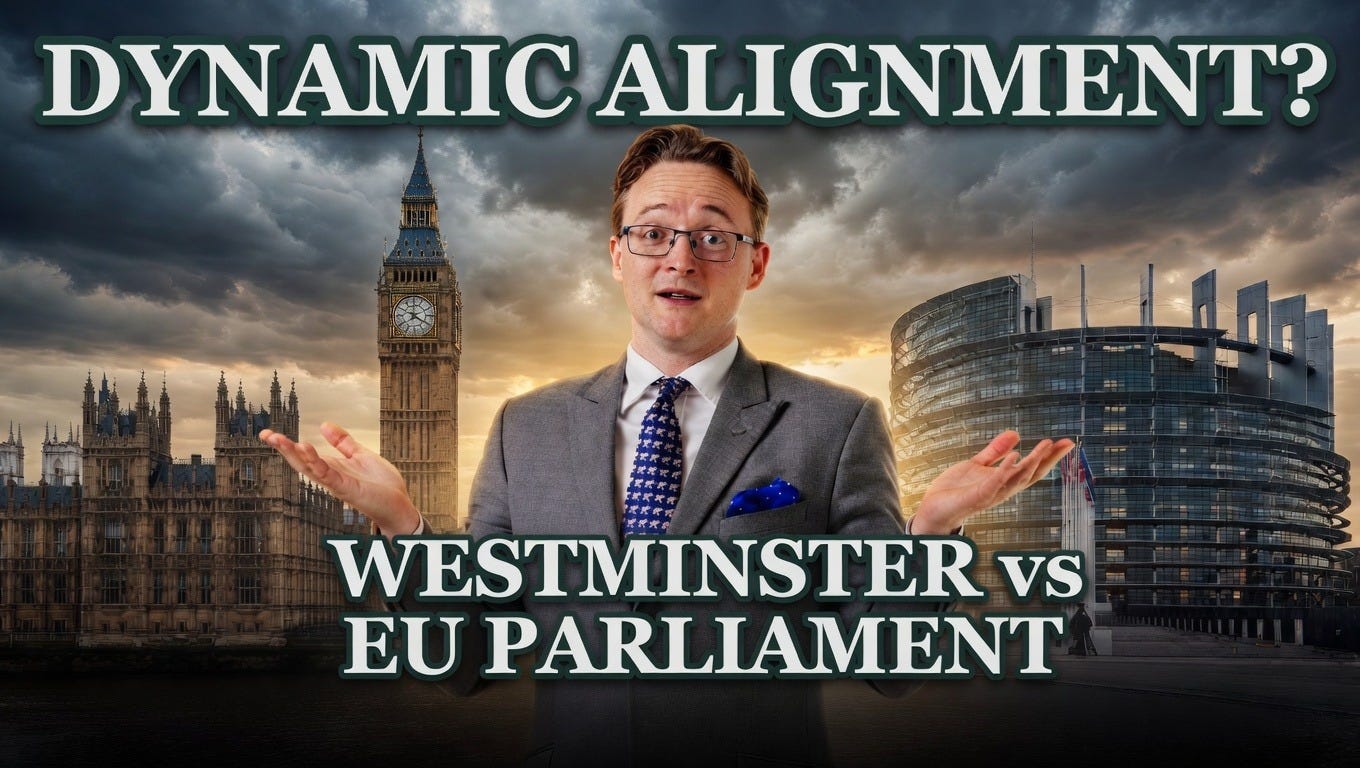
Whether we like it or not, the European Union is once again going to play a greater role in the life of the British people. This Government has tired of Britain’s short-lived experiment in sovereignty and democracy and is returning to its comfort zone: an office in the Berlaymont building.
Thanks to the Government’s plans to forge a closer relationship with the European Union, the European Commission—the unelected, centralising, regulatory behemoth in Brussels—is going to dictate the rules and regulations that British businesses must follow every day.
In May, the Government is expected to introduce legislation to Parliament which will defer policy-making authority to the European Union and embrace so-called “dynamic alignment” with the EU on areas of food and hygiene standards, electricity market regulation, and industrial energy costs. According to some briefings, this could go further and embrace all regulations for the entire physical economy.
Dynamic alignment means Britain will choose not just to align with EU laws and regulations today. It means that Britain will align with EU laws forever. If the EU changes its regulations, we will change ours to match. For a country which prides itself on having a supreme Parliament which has total lawmaking authority in its domain, this is a remarkable course of action. Parliament would no longer be Britain’s supreme lawmaking institution; instead it will take orders from a foreign body.
Norway has a similar arrangement with the EU. It is known there as “government by fax machine”, as Oslo waits for the latest rules from Brussels to come in. Switzerland does as well, as part of a complicated web of bilateral deals between Bern and Brussels, in which both parties haggle over the details of market access and financial settlements. Neither side particularly enjoys it.
So why is His Majesty’s Government choosing to abandon parliamentary sovereignty, at least in the realm of the physical economy, and remove Britain’s MPs and Britain’s voters from deciding the laws which affect them?
The stated reason is for a stronger trading relationship, the reduction of trade barriers, better diplomatic ties with the EU, and lower costs for business in a time of global turbulence. There are many problems with these arguments, some of which are incorrect, and others which fall when one considers the EU’s intentions towards Britain. The unstated reason being the “EU Reset” — known euphemistically as a “Common Understanding” by the EU—is that it serves as a step towards rejoining the European Union.
Do we need a stronger trading relationship with the EU?
Free and open trade is a great thing and something we should all support. This is what the UK has with the EU and has done since 2021 when Brexit became a reality. The Trade and Cooperation Agreement is a comprehensive free trade agreement, which guarantees tariff-free and quota-free market access between Britain and Europe. Importantly, this agreement allows for regulatory divergence if either party wishes.
There are some trade barriers in this arrangement, however. Because the EU did not agree to Britain’s request for a mutual recognition agreement when it came to food and sanitary standards—known as SPS regulations—similar to that which the EU agreed with New Zealand, many British agrifood exports to the EU must have Export Health Certificates to demonstrate that they meet the EU’s standards. While this is normal practice for international trade, it was a change from how trade worked within the EU, with no checks of any kind. This has added costs and bureaucracy, which cannot be denied, and smaller businesses have found it more expensive to export with the EU. However, has it damaged trade?
After a period of adjustment in 2021 and 2022, it is hard to say that it has. Britain left the EU in the midst of the pandemic, when the global economy had been functionally switched off. Economic demand had been crushed, and soon after the British and European economies had fully reopened came the energy crisis sparked by the war in Ukraine. Energy prices boomed and inflation soon followed, peaking at over 11 percent in Britain and at a similar level on the continent. In this period, Europe’s legacy industries suffered serious damage: the British fertiliser industry vanished—and hasn’t returned—and Germany, once Europe’s workshop, saw the collapse of industries from chemicals to cars, under the weight of high energy costs. This is the main story of Britain and Europe’s sluggish growth over the last five years, not the introduction of new customs procedures.
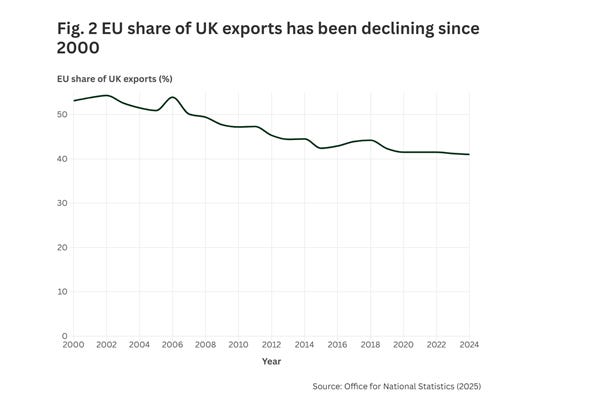
Trade between Britain and Europe recovered from 2023 onwards. Supply chains adjusted to the new legal framework and British and European businesses resumed trade. Today, Britain’s goods and services exports to the EU are at record highs in terms of value. Meanwhile, Britain has been able to deepen its trading relationship with non-EU markets as well, which account for a majority of British trade today, continuing a trend which has been growing for around 20 years.
Though the Government believes that pursuing dynamic alignment with the EU for food standards will increase trade, it does not seem like it will make much difference at all. For example, British lamb and beef exports to the EU are reaching record highs, and British farmers have opened new export markets outside the EU as well. Seeing as Britain is the largest producer of lamb in Europe, it is hard to believe that the alignment of standards would make much difference to British exports to the EU, which have much more to do with cost, availability, and demand.
Furthermore, some of the largest value exports from the UK to the EU, like whisky and gin, do not require sanitary and phytosanitary (SPS) checks for export, so will not see any change to trade after the Government’s Reset. In 2025, the Prosperity Institute’s report, A Road to Nowhere highlighted how the trade relationship between the UK and the EU remained strong overall, with some standout sectors and others lagging. In many respects, this is similar to the trading relationship that Britain had with the rest of the EU while a member: British exports were led by a wide range of services and top-end manufacturing, while being a net importer of food and mass market goods.
Where exports to the EU have declined—cereals, langoustines and seed potatoes, for example—it is not necessarily the case that this was caused by the requirements of SPS approval. Strict import protocols have made it harder to sell shellfish and seed potatoes into the EU, however the trade in cereals has been damaged by declines in production. 2024 and 2025 saw some of the worst harvests in recent years in Britain, and British farmers can now often make more money by turning their fields into state-subsidised “rewilding” meadows than they can from growing cereals in them. If growing conditions, the cost of fertiliser, and warped incentives are depressing production, this will ultimately have affect British exports. A country cannot export what it does not produce.
What is true for agrifood is also true for industrial goods. British industrial output is declining and has been for some time, largely thanks to Britain’s prohibitive energy costs. As the Prosperity Institute’s 2025 paper, Destroying the Foundations, highlighted, British energy consumption has declined since a peak in the early 2000s, and energy costs have reached record highs. This is hammering industrial output. As our Road to Nowhere paper argues, British trade with the EU would be strengthened by domestic economic reform to increase British output, rather than a renegotiation of trade procedures.
Will this reduce cost for British businesses?
This agreement is being sold as a cost saving to British businesses by the Government. It claims that reduced trade barriers from dynamic alignment would save British businesses hundreds of pounds per shipment to the EU, with aggregate gains to the economy of around £9bn by 2040.
The number of businesses which may benefit from this directly is very small. Roughly 8 percent of businesses export to the EU in total. Those which export food and drink products in scope of EU Reset will be even smaller. The Food and Drink Federation estimate that there are 12,500 food and drink businesses which trade with the EU in some form. This is around 0.2 percent of British businesses overall. Therefore, the cost saving of these changes may only be enjoyed by a small number of exporters. Meanwhile the Growth Commission estimates that aligning with EU SPS rules could cost the British economy around £15bn, far more than the purported benefits of the Reset.
The Government also claims that British exporters of manufactured goods will gain from the alignment of UK ETS (Emissions Trading Scheme) prices with EU ETS prices. This is the carbon tax imposed on heavy industrial energy use. The EU ETS is approximately 40 percent higher than the UK’s, so it is a strange logical leap to suggest that increasing carbon taxes on businesses will actually cut their costs, but the Government claims it will because it will avoid British industrial exports being sent to the EU facing a Carbon Border Adjustment Mechanism, a type of carbon tariff. The Government estimates that this will stop British exports facing tariffs worth around £800m per year.
This is flawed on two levels. First, the tariff would not be paid by British businesses, instead it would be paid by European consumers. Therefore, it is not a cost saving on British exports. Second, considering the UK’s ETS revenues were around £2.5bn in 2024 and 2025, raising ETS prices to EU levels is equivalent to an extra £1bn in additional taxes on British businesses, larger than the mooted cost saving of avoiding the CBAM. Seeing as not all British businesses which pay ETS also export manufactured goods to the EU, this policy is little other than a crude and damaging tax rise on British businesses, which will limit Britain’s ability to compete with its neighbours in Europe. Indeed, Prosperity Institute research finds that ETS linkage will increase the carbon taxes on data centres by nearly 60 percent, and will add around £46 to household bills.
Will this improve British prosperity?
While the EU Reset has been sold as a policy which will benefit British exporters, its negative effects will be felt across the whole economy. Dynamic alignment means that British businesses are going to have to follow EU rules whether they export to the EU or not. British taxpayers are going to be expected to pay into the EU’s budgets to fund EU regulators to inspect British businesses in the food supply chain; British farmers will have to change which fertilisers or seeds they use to comply with EU rules; and the British people will be asked to pay into EU cohesion funds which will be spent in the EU.
This is not a recipe for prosperity. While not precisely the same as the policies included in the EU Reset, the Prosperity Institute found that if the UK were to rejoin the EU’s Customs Union would knock £40bn off the British economy in a single year, and even more thereafter.
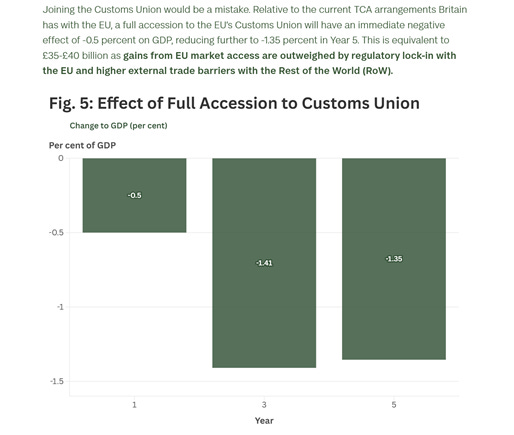
This is because joining the Customs Union, much like the EU Reset, and the Prime Minister’s mooted plan to realign with all EU Single Market Regulations, would aggressively reorient the centre of gravity of the British economy back to Europe, against a long-term trend away from it.
The EU is a declining share of the global economy with poor demand. A policy of realignment with the EU would be one which would not only preclude Britain from exploiting trade and economic opportunities elsewhere, but it would also lock the UK into the EU’s poor regulatory policy, which has been widely blamed as the main reason for its poor economic performance in the twenty-firstt century.
Can we trust the EU?
The EU has expansionist designs on Britain. It treats countries on its periphery like economic subordinates, and this has characterised its approach to Brexit. Theresa May’s premiership collapsed after she agreed a deal with the EU in which Britain would follow EU rules and regulations in perpetuity, and Sir Keir Starmer is about to take Britain into a similar arrangement.
Dynamic alignment would be the starting point of a ratchet effect of ever-closer alignment with the EU and the continued erosion of parliamentary sovereignty. If the EU moves further away from consensus-based policymaking among its members and towards more Qualified Majority Voting, it is likely that we will see much more aggressive regulatory policymaking by the EU Commission. This will be bad for Britain, as it is buffeted along by the EU’s centralising instincts, where regulation is used as a form of protectionism and industrial strategy to benefit the EU’s legacy industries.
The settlement of the Windsor Framework shows how the EU may operate. By keeping Northern Ireland within the EU’s Single Market, the Framework has been used to limit economic divergence between the UK and the EU, lest trade barriers emerge between Great Britain and Northern Ireland. It has therefore kept Britain in the policy orbit of Brussels. However, the EU has attempted to use the Framework in a more avaricious manner and impose some of its worst regulations on the UK.
In 2025, the EU proposed that the EU’s AI Act—which includes some of the world’s most damaging restrictions on innovation, to the detriment of the European economy—be applied to Northern Ireland via the Windsor Framework. It argued that as AI is being used in a growing number of consumer goods, the safety of the EU’s Single Market could be threatened by AI-powered electronics coming into use in Northern Ireland. Thankfully, the British government rejected this proposal, but it is a sign of the sort of methods the EU will use if it sees an opportunity to limit British competitiveness. The EU attempted to stop the export of vaccines to the UK in the pandemic via Northern Ireland, and it continuously engages in painful negotiations with the Swiss, trying to reduce Swiss market access to Europe and enforce conformity with EU regulations.
This is the reality of dynamic alignment. It puts Britain in a subordinate position. By aligning with food standards and energy costs, Britain will lose the ability to pursue policies which will grow the economy. This is especially true when it comes to energy policy, in which dynamic alignment will relegate Britain to the status of a captive market for EU exports, instead of being a competitive and welcoming place to invest and grow businesses.
Democracy denied
The EU Reset will be bad for the British economy, but worst of all it will be bad for British democracy. If it comes to pass, it will amount to our own Parliament deciding that it should not be responsible for governing the country and acting in the interests of its own electorate. As the call to rejoin the EU grows louder from various corners of Whitehall, it seems that the EU Reset is not the final destination, but the beginning of a new journey back to the Berlaymont.
